AI DICOM Objects
DICOM objects generated by artificial intelligence
AI inference rarely defines its own file formats — instead, results are packaged as standard DICOM objects so any compliant PACS or viewer can ingest them. The same SOP Classes used for human-authored content (segmentations, structured reports, presentation states…) are reused to carry model outputs.
This page maps the AI-produced object types you are most likely to encounter to how Weasis displays them.
| Category | Object type | What AI typically uses it for |
|---|---|---|
| Image outputs | Secondary Capture | Pre-rendered images with burned-in annotations or heatmaps |
| Enhanced Objects | Denoised, super-resolved, or otherwise reconstructed images | |
| Parametric Map | Per-pixel probability maps, heatmaps, perfusion/diffusion maps | |
| Overlays on source images | Segmentation (SEG) | Pixel-based labels for anatomy or lesions |
| RTSTRUCT | Vector contours for anatomy or regions of interest | |
| Presentation State (GSPS) | Vector annotations, measurements, display settings | |
| Reports & documents | Structured Report (SR) | Findings, measurements, classification results |
| Encapsulated Documents | PDF reports, attached non-image data |
Image outputs
These objects carry their own pixel data and are viewed as standalone images.
DICOM Secondary Capture (SC)
Pre-rendered images where the AI has burned its output directly into the pixels — typically annotations, heatmaps, or side-by-side comparisons. Convenient for legacy viewers, but the overlay cannot be toggled off or recomputed.
Info
Secondary Capture displays like any other image, see DICOM 2D Viewer.
DICOM Enhanced Objects
Reconstructed or post-processed images — for example denoised CTs, super-resolved MRs, or motion-corrected series. The output replaces or complements the original acquisition rather than annotating it.
Info
Enhanced images display like any other image. Overlays, shutters, and pixel padding stored in the object are honored by the rendering pipeline — see 2D Viewer Display.
DICOM Parametric Map (PMAP)
Single- or multi-frame images whose pixel values represent a derived quantity rather than an acquisition signal — common carriers for AI probability maps, class-activation heatmaps, perfusion (rCBF, rCBV, MTT), diffusion (ADC), and PET-derived metrics.
Info
Weasis renders Parametric Maps as standard images, including the float and double pixel representations that AI pipelines typically emit. Window/level and LUT controls apply normally — pick a suitable LUT to interpret the value range.
Image overlays
These objects do not contain a viewable image of their own; they reference a source series and are drawn on top of it.
DICOM Segmentation (SEG)
Pixel-based labels produced by segmentation models — anatomical structures, lesions, organs at risk, etc. Each segment is stored as a binary or fractional mask and is independently toggleable in the viewer.
Info
See DICOM SEG for displaying DICOM SEG objects in Weasis, including in MPR and the 3D Volume Renderer.
DICOM RTSTRUCT
Originally designed to describe contours for radiotherapy planning, RTSTRUCT is also used by AI tools that output vector geometry instead of pixel masks. Lighter to store than SEG, but inherently 2D per slice.
Info
See DICOM RT for displaying DICOM RTSTRUCT objects in Weasis.
TotalSegmentator is a good example: starting from version 2, its automatic segmentation of 100+ anatomical structures on CT can be exported as DICOM RTSTRUCT — and, in recent releases, as DICOM SEG as well — both of which load directly in Weasis without any extra configuration.
DICOM Presentation States (GSPS)
Grayscale Softcopy Presentation States store the display intent for an image — window/level, zoom, rotation — together with vector annotations and measurements. AI tools use them to ship findings as toggleable overlays on the original images rather than baking them into pixels.
Info
See DICOM PR for displaying DICOM Presentation States in Weasis.
Reports & documents
These objects carry structured or document content rather than imagery.
DICOM Structured Report (SR)
Tree-structured findings: measurements, classifications, observations, and references back to the images they describe. The standard delivery format for AI tools that need to expose interpretable, machine-readable results.
Info
See DICOM SR Viewer.
DICOM Encapsulated Documents
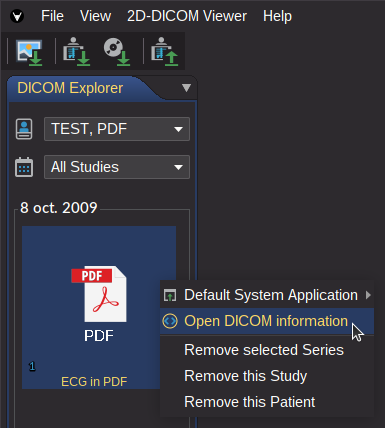
Wrappers for non-image content (PDF, STL, MPEG, plain text…). Useful when an AI pipeline produces a full report or auxiliary artifact that would otherwise live outside the imaging study.
Info
Encapsulated documents are opened with the system application registered for the document MIME type. The DICOM attributes can be inspected from the thumbnail context menu.